Sage Jenkins · 22 November 2026
AI Oversight Talks Encourage Cambridge Labs to Partner with Welsh Wind Initiatives on Data Security Tools
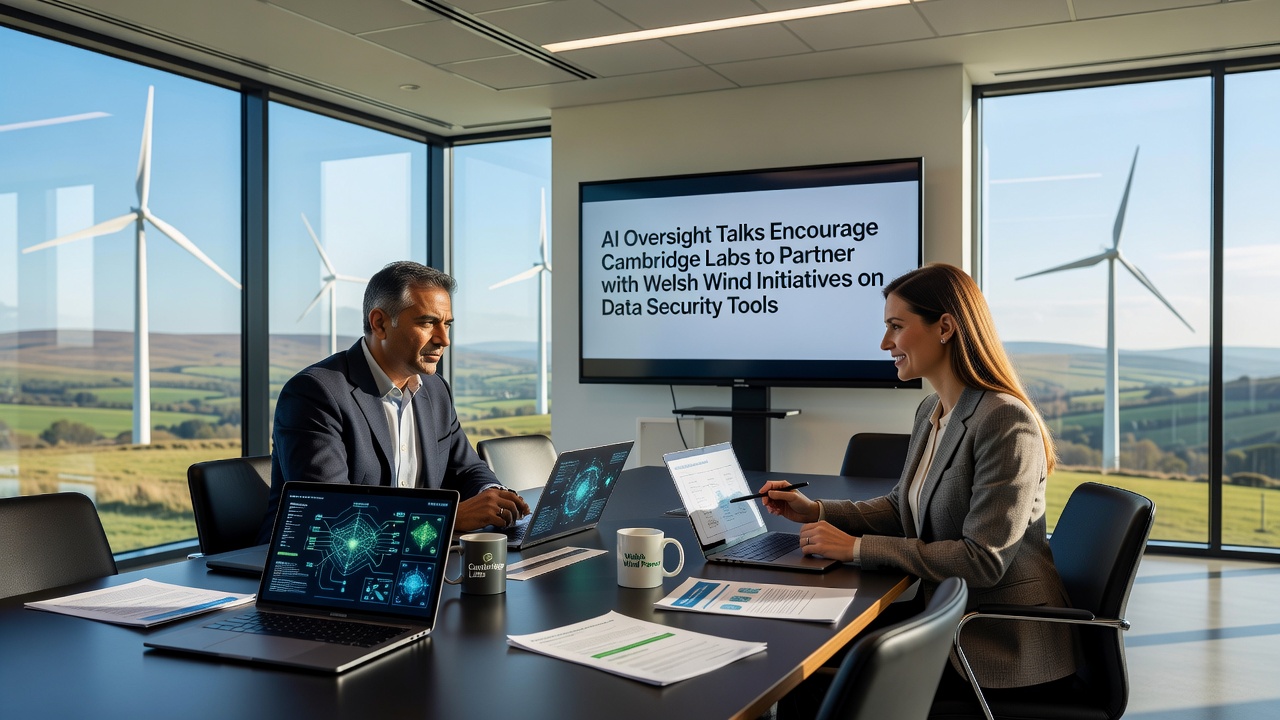
Recent discussions on artificial intelligence governance have prompted laboratories in Cambridge to form partnerships with wind energy projects in Wales focused on developing advanced data security tools, and these collaborations draw on regulatory frameworks that emerged from international meetings held through late 2026. Observers note that talks in November 2026 highlighted the need for robust protections in AI applications tied to renewable energy infrastructure, leading Cambridge-based teams to align with Welsh initiatives that manage large-scale wind farm data networks. Data from government reports shows increased emphasis on cross-regional cooperation where AI systems process operational metrics from turbines and grid connections.
Background on Oversight Developments
Meetings convened by regulatory bodies across multiple jurisdictions examined how AI tools integrate with energy sectors, and findings from these sessions indicated gaps in data handling protocols that affect both academic research environments and commercial wind operations. According to analyses released by the National Institute of Standards and Technology, organizations handling sensitive datasets in renewable projects require enhanced encryption and access controls to meet emerging standards. Those involved in the Cambridge labs responded by exploring joint ventures that combine machine learning expertise with practical wind monitoring systems deployed along Welsh coastlines.
Cambridge Laboratory Capabilities
Teams at Cambridge facilities have long specialized in algorithmic models that analyze complex datasets, yet recent oversight requirements pushed them toward specialized security applications. Researchers discovered that wind initiative operators collect terabytes of performance and environmental data daily, creating vulnerabilities if not properly safeguarded. Partnerships formed in the wake of the November 2026 sessions now focus on building tools that embed privacy-preserving techniques directly into AI pipelines used for predictive maintenance and load balancing across wind arrays.
Evidence from project summaries reveals that Cambridge experts contribute knowledge in federated learning methods, while Welsh partners supply real-time data streams from operational turbines. This combination allows testing of security protocols under live conditions without exposing raw information to external networks. Studies conducted at affiliated institutions further demonstrate how such integrations reduce risks associated with data breaches in distributed energy setups.
Welsh Wind Initiatives and Their Data Needs
Wind projects scattered across Wales rely on interconnected sensors and control systems that generate continuous streams of information, and these operations face mounting pressure to comply with data protection guidelines discussed at oversight forums. Operators report that AI-driven analytics improve efficiency in turbine performance forecasting, but only when underlying datasets remain secure from unauthorized access. Collaborations initiated after the 2026 talks address this by developing customized encryption layers tailored to the intermittent connectivity challenges common in remote coastal installations.

Figures released through industry reports indicate that Welsh wind farms expanded their sensor networks by over 30 percent between 2024 and 2026, increasing the volume of data requiring protection. Partnerships with Cambridge labs introduce solutions such as homomorphic encryption that permit computations on encrypted information, and these methods align with recommendations from international bodies including the Australian Department of Industry, Science and Resources. Teams working on the ground observe that this approach maintains operational continuity while satisfying governance expectations set during the oversight dialogues.
Partnership Mechanics and Tool Development
Joint working groups established between the two regions meet regularly to prototype data security modules, and initial outputs include dashboards that flag anomalies in data access patterns across both laboratory simulations and live wind sites. One case documented in project updates involved Cambridge algorithms detecting potential intrusion attempts in a Welsh testbed, which prompted refinements to authentication procedures used by turbine operators. Such iterative development reflects patterns seen in other cross-sector AI applications where oversight prompts faster adoption of protective measures.
Funding allocations tied to these efforts come from regional innovation grants that support technology transfer between academic centers and energy projects, and records show several pilot implementations scheduled for rollout in early 2027. Data security tools emerging from this work incorporate elements like differential privacy to mask individual data points while preserving aggregate insights valuable for grid management. Observers note steady progress as both parties refine interfaces that allow seamless integration without compromising either research integrity or operational security.
Broader Implications for Regional Collaboration
Similar arrangements appear in other parts of the United Kingdom where AI oversight conversations intersect with infrastructure projects, yet the Cambridge-Wales link stands out for its focus on renewable energy datasets. Reports from academic consortia highlight measurable improvements in threat detection rates when security tools undergo validation against actual wind farm telemetry. These outcomes stem directly from the structured exchanges encouraged by the 2026 talks and demonstrate how regulatory signals can accelerate practical technology sharing.
Additional examples include shared repositories for anonymized test data that enable broader validation of security protocols without risking proprietary details. Participants from both regions continue to document lessons learned, contributing to a growing body of case material referenced in subsequent policy reviews. The approach avoids duplication of effort by leveraging existing strengths in each location rather than building parallel systems from scratch.
Conclusion
Partnerships between Cambridge laboratories and Welsh wind initiatives continue to advance data security tools shaped by AI oversight discussions, and ongoing work scheduled through 2027 builds on foundations laid in November 2026. Records from participating organizations confirm that these efforts produce tangible prototypes tested against real operational demands, while drawing on guidance from sources such as the National Institute of Standards and Technology and the Australian Department of Industry, Science and Resources. The resulting tools address specific vulnerabilities in energy data systems and illustrate how regional expertise combines effectively under coordinated governance frameworks.